









If you already wear contacts or glasses and your near vision has started to fade, switching to varifocal contact lenses is worth a look. Varifocals correct near, intermediate, and distance vision in a single lens, so you can read, look at a screen, and see across the room without swapping between pairs. They are also called multifocal or progressive lenses, and they are built for the natural decline in close-up focus that comes with age. Whether you should switch depends on your eyes, your lifestyle, and how much you rely on reading glasses now.
Most people who make the switch are in their 40s or older and dealing with presbyopia. If you have caught yourself holding your phone at arm’s length or reaching for readers on top of your contacts, that is usually the sign it is time to look at varifocals.
What Changes When You Switch to Varifocals?
A standard contact lens carries one power across the whole lens. A varifocal lens builds several powers into different zones, so your eye can focus at more than one distance through the same lens.
The shift most people notice is that they stop reaching for reading glasses. Your brain learns to use the zone that matches what you are looking at, the same way it adapts to progressive eyeglasses, but with no visible lines on the lens. Varifocal contacts come in soft and rigid gas permeable materials. Soft lenses suit most wearers for comfort, while rigid lenses can give sharper vision for certain prescriptions. Both are sold in daily, biweekly, and monthly replacement schedules.
Presbyopia is a normal part of aging, not an eye disease. It affects nearly everyone eventually, usually becoming noticeable in the early to mid 40s as the lens inside the eye loses flexibility.
Who Should Make the Switch?
The strongest candidates are people with presbyopia who are tired of juggling reading glasses. Presbyopia sets in when the lens inside your eye stiffens with age and struggles to focus up close, usually from the early to mid 40s onward.
You are also a good candidate if you have presbyopia together with another refractive error like nearsightedness, farsightedness, or astigmatism, since a varifocal lens combines those corrections into one. Active people, those who work across several screen distances, and anyone who dislikes the look or hassle of bifocal glasses tend to benefit most. A fitting with your optometrist is the surest way to know if they suit your eyes.
What Are the Types of Varifocal Lenses?
Varifocal lenses lay out their correction zones in different ways. Your optometrist will suggest a design based on your prescription and how your eyes move through the day.
- Concentric. A central zone, usually for distance, is ringed by alternating zones for near and far. The rings allow smooth shifts between distances.
- Aspheric. The power blends gradually across the lens rather than in sharp steps, giving a more natural change of focus.
- Segmented. Built like a bifocal, with distance vision in the upper portion and near vision in the lower portion.
How Do Varifocal Contacts Compare to Other Options?
If you are weighing the switch, it helps to see how varifocal contacts line up against the alternatives Canadians commonly use for presbyopia.
| Option | Distances Corrected | Main Trade-off |
|---|---|---|
| Varifocal Contacts | Near, intermediate, and far | Short adjustment period |
| Reading Glasses | Near only | No help with distance vision |
| Bifocal or Progressive Glasses | Near and far | Frames and visible field limits |
| Monovision Contacts | Near and far, split between eyes | Can reduce depth perception |
Varifocal contacts are the only option here that handle the full range of distances without frames. That is why active wearers and people who dislike glasses tend to choose them. Trusted lens names like ACUVUE, AIR OPTIX, Biofinity, and DAILIES all make varifocal options across a range of prescriptions.
How Long Is the Adjustment Period?
Most people adapt within a few days to a few weeks. Your eyes and brain need time to learn how to use the lens zones, and during that period your vision may feel slightly different than usual, particularly in dim light or when you change focus quickly.
Give the lenses a fair trial before deciding. If your vision still feels off after a few weeks, your optometrist can adjust the power or move you to a different lens design. A precise fit is rarely reached on the first attempt, which is why a professional fitting is part of the process in Canada.
In Canada, a contact lens fitting is a separate service from a standard eye exam. Varifocal contacts always require this fitting, which produces the prescription you need before ordering.
How To Insert and Care for Varifocal Contacts
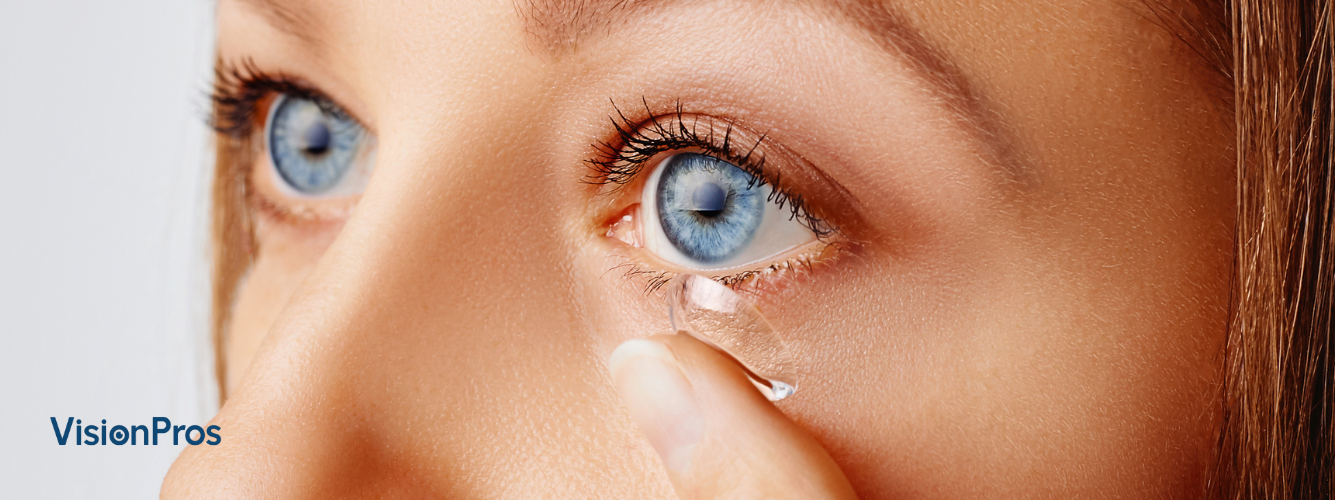
Varifocal lenses go in and come out like any soft contact lens. A few habits keep wear safe and comfortable.
- Wash and dry your hands before handling your lenses to keep bacteria away from your eye.
- Check the lens is not inside out and has no tears before putting it in.
- If your vision is blurry after insertion, remove the lens, rinse it, confirm the orientation, and reinsert.
- Follow your replacement schedule and see your optometrist if discomfort or blur continues.
Frequently Asked Questions
Are varifocal and multifocal contacts the same thing?
Can I switch to varifocal contacts if I have astigmatism?
Do I need a new prescription to switch to varifocals?
How soon will I see clearly after switching?
What if varifocals are not right for me?
References
Canadian Association of Optometrists. Presbyopia and Aging Eyes. CAO.ca. 2023.
American Academy of Ophthalmology. Multifocal Contact Lenses. AAO.org. 2023.
Health Canada. Medical Devices and Contact Lenses. Canada.ca. 2023.
National Eye Institute. Presbyopia. NEI.NIH.gov. 2023.