









Daily contact lenses usually cost more than monthlies if you wear them every day. But if you mainly wear glasses and use contacts occasionally, daily disposables can work out cheaper.
Canadian retail prices collected in September 2026 illustrate the difference. For standard spherical prescriptions, our central estimates put a full year of daily lenses at approximately $892, compared with $385 for monthly lenses including a modelled allowance for cleaning solution.
That’s a difference of about $507 a year, or $42 a month.
Your own result depends on your prescribed lenses, how frequently you wear them, solution costs and the total charged at checkout.
All prices below are in Canadian dollars. “Dailies” refers to daily disposable contact lenses generally, including products beyond Alcon’s DAILIES brand.
What daily and monthly contacts cost in Canada
A fair comparison starts with enough lenses for both eyes over the same period. It also includes the care solution needed for reusable lenses.
The following estimates use Canadian competitor prices from our September 2026 research.
| Prescription type | Monthly lenses for 12 replacement cycles | Monthly lenses plus solution | Daily lenses for 365 days | Additional annual cost of dailies |
|---|---|---|---|---|
| Spherical for nearsightedness or farsightedness | $224 | $385 | $892 | $507 |
| Toric for astigmatism | $347 | $508 | $1,393 | $885 |
| Multifocal for near and distance vision | $428 | $589 | $1,525 | $936 |
These are illustrative benchmarks derived from the sampled products, rather than national spending averages or quotes for a specific prescription. Monthly totals include approximately $161 in solution consumption. Shipping, applicable tax, professional care and insurance reimbursement are excluded.
The daily figures represent the value of lenses used over 365 days. Buying whole boxes can require a larger payment, with lenses left for the next year.
For everyday spherical wear, the comparison works out to approximately $2.44 per day for daily disposables and $1.06 per day for monthlies with solution.
Toric and multifocal daily lenses carry larger dollar premiums in this sample. However, the monthly toric and multifocal benchmarks each represent one product, so they should not be read as complete market averages.
Why the box price can be misleading
The number printed on the box does not tell you how long it will serve both eyes.
- A 90-pack of daily lenses contains 90 individual lenses. Two boxes provide 90 days of wear for both eyes.
- A six-pack of monthly lenses contains six individual lenses. Two boxes provide six monthly replacement cycles for both eyes.
That is why a $110 box of daily lenses and a $56 box of monthlies cannot be compared simply by their sticker prices.
For the monthly products in this study, four six-packs cover 12 replacement cycles for both eyes. Eight 90-packs of daily lenses cover 360 days, falling five days short of a 365-day year.
Those small distinctions matter when an advertised “annual supply” becomes your household budget.
How much does solution add to monthly lens costs
Monthly lenses have an ongoing care expense that daily disposables avoid.
Our September 16 research compared exact solution packs at Walmart Canada, Shoppers Drug Mart, Well.ca, Real Canadian Superstore and Jean Coutu. The accepted observations included:
- Biotrue Advanced, two 300 mL bottles, at $21.97–$29.49.
- OPTI-FREE PureMoist, two 300 mL bottles, at $24.99–$29.49.
- CLEAR CARE Plus, two 360 mL bottles, at $24.97–$30.49.
Using the median observed price for the multipurpose solutions, annual consumption costs approximately $129 at 8 mL per care day, $161 at 10 mL and $193 at 12 mL, assuming 365 care days.
These are budgeting scenarios. The amount you use depends on the product’s directions, including rubbing, rinsing and filling the case. Follow those directions rather than treating a modelled volume as a recommended amount.
At the spherical lens benchmark, adding the low-to-high solution scenarios brings monthlies to approximately $353–$417 annually. That remains below the $892 daily-disposable benchmark for everyday wear.
Whole-bottle purchases, discarded solution and any separately purchased cases can increase the amount you actually spend.
When occasional wear makes dailies cheaper
Daily lenses become more competitive when you use them only for certain activities or days of the week.
You open a fresh pair when you need them. With monthlies, the replacement period continues after opening even if you wear glasses between uses. Monthly lenses are not a bank of 30 separate wearing days. DOYLE’s Canadian guidance makes this distinction explicitly.
To see how wearing frequency changes the calculation, start with the spherical benchmarks:
- Daily lenses cost approximately $2.44 for each day both eyes are fitted.
- Monthly lenses cost $224 for 12 replacement cycles, before care.
The table below shows how much annual care spending monthlies can accommodate before they cost the same as dailies.
| Wearing pattern | Days of wear per year | Value of daily lenses used | Annual monthly care budget at equal cost |
|---|---|---|---|
| One day per week | 52 | $127 | None — monthly lenses alone cost $97 more |
| Two days per week | 104 | $254 | About $30 |
| Three days per week | 156 | $381 | About $157 |
| Five days per week | 260 | $635 | About $411 |
| Every day | 365 | $892 | About $668 |
This assumes you open a monthly pair throughout all 12 replacement cycles. It excludes delivery, tax and whole-box purchase rounding.
At one day per week, daily lens consumption costs less than the monthly lenses alone under these assumptions.
At two days per week, monthlies leave only about $30 for annual solution and case costs before reaching the daily total.
At three days per week, the result is closer. Monthlies cost less if annual care spending is below approximately $157; dailies cost less if care spending exceeds that amount, with other costs held equal.
This is more useful than a universal rule that one format becomes cheaper at exactly three days a week. Your lens prices and care spending determine the crossover.
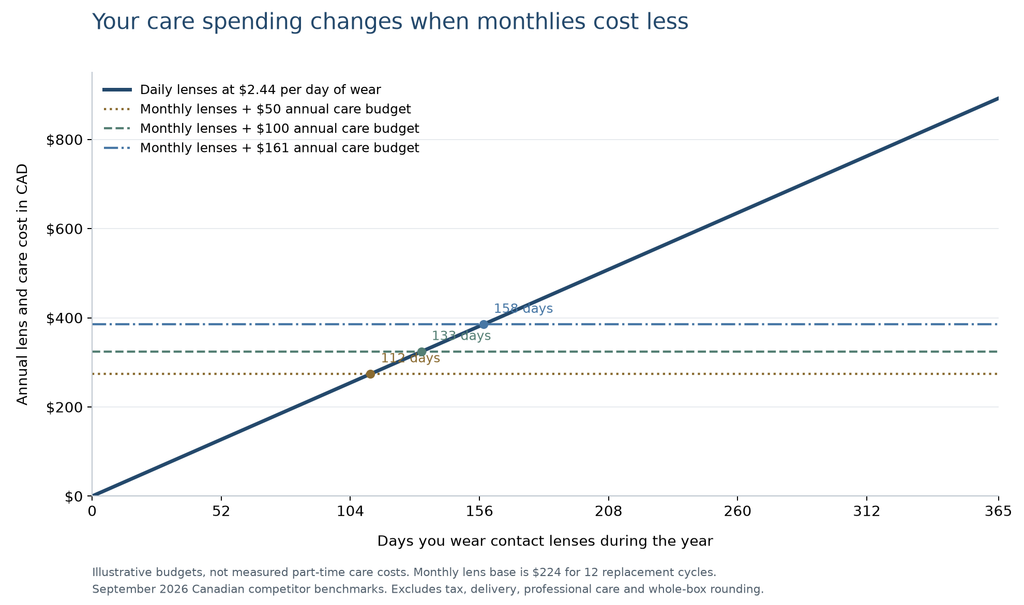
The chart’s care budgets are illustrative. They are not measured costs for particular wearing schedules. Storage requirements, re-disinfection and solution discard instructions can affect occasional wearers’ spending.
Seasonal wear needs a different calculation
Wearing contacts every Saturday throughout the year differs from wearing them frequently during a short season.
If you only open monthly lenses during three replacement cycles, a full 12-cycle monthly budget would overstate the value of lenses used. At the spherical benchmark, three pairs represent about $56 in lens consumption, plus care.
The initial purchase may still cost more because you buy boxes containing additional pairs.
For seasonal wear, count both the days you expect to wear contacts and the replacement cycles during which you will open reusable lenses.
What you spend today can differ from what you use
An annual usage estimate answers one question. The amount charged to your card answers another.
Using the $109.99-per-90-pack daily benchmark, two boxes cost approximately $220 and provide 90 days of wear for both eyes.
If you wear contacts once a week, the value used over 52 days is approximately $127. The remaining lenses stay in your supply, subject to their expiry dates and your prescription remaining suitable.
The same issue appears at the other end of the scale. Someone starting with no lenses and buying exclusively in 90-packs would need ten boxes to cover 365 days if each eye requires its own prescription. Those boxes supply 450 days for both eyes, leaving 85 days for later use.
Smaller packs may reduce the initial commitment, but their price per lens can differ.
When comparing formats, consider both the annual value consumed and the amount you need to pay upfront.
What else changes the cost for Canadian wearers
Shipping and mandatory fees
Small refills can carry a disproportionately large delivery cost.
In our September checkout research, one retailer’s $14.95 shipping charge added approximately 20% to a two-box Biofinity merchandise subtotal, compared with about 10% on four boxes.
That example concerns monthly lenses. It illustrates why the quantity you actually order matters, rather than establishing a delivery-cost advantage for either format.
Compare your intended basket, including fees and any destination restrictions on free shipping.
Discounts and rebates
An immediate discount reduces today’s payment. A manufacturer rebate may require an eligible product, purchase quantity, retailer and successful claim.
Keep those amounts separate. Likewise, a first-order or introductory subscription offer may not represent what you pay on subsequent orders.
Tax and insurance
Prescription contact lenses can qualify for zero-rated GST/HST treatment when the relevant conditions are met. The supplier needs sufficient evidence of a valid prescription or assessment record, according to CRA guidance. Solution purchases can have a different tax treatment, so compare the actual invoice lines.
If you have vision benefits, check the reimbursement limit, renewal period and eligible expenses. A benefit can reduce your out-of-pocket spending, but its effect depends on your plan and how much of the allowance remains.
Is the extra cost of dailies worth it
For everyday spherical wear, the central comparison puts the daily-disposable premium at approximately $1.39 per day after allowing for monthly-lens solution.
For some wearers, a fresh pair each day and avoiding a reusable-lens cleaning routine justify that expense. Others prefer the lower ongoing cost of suitable monthly lenses.
For occasional wearers, daily disposables may offer both convenience and lower annual consumption costs.
The financial comparison is most useful once your optometrist has identified suitable options. A lower price does not establish that a different brand, material or replacement schedule will work for your eyes. CooperVision Canada’s guidance recommends professional fitting when changing lenses.
About the prices and calculations
This comparison uses the September 2026 competitor price snapshot behind our Canadian contact lens price study, supplemented by solution observations collected on September 16, 2026.
The benchmarks use the median retailer price for each sampled product, then the median of those product figures within each category. Coverage includes seven spherical, three toric and two multifocal daily products, plus three spherical, one toric and one multifocal monthly product. Retailer coverage varies by product.
Daily costs are calculated per lens and multiplied by two eyes and the stated wearing days. Monthly costs use 12 replacement cycles. Weekly examples use 52 weeks; everyday wear uses 365 days.
Figures are rounded and describe a dated retail sample. They exclude professional examinations and fittings, delivery, applicable tax, insurance reimbursement and unexpected lens replacement unless stated otherwise.
VisionPros.ca commissioned and hosts the research. Its own prices are excluded from these comparisons.