








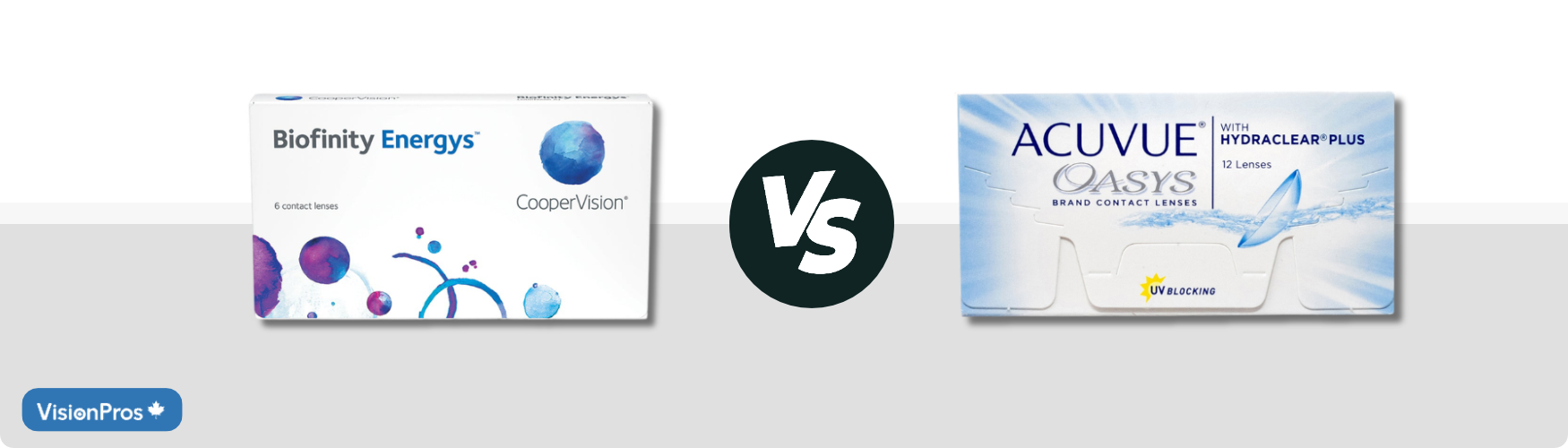
Biofinity Energys and Acuvue Oasys are both popular contact lens options for people who spend long hours on screens, but they take different approaches to comfort. Both are reusable silicone hydrogel lenses that allow plenty of oxygen to reach the eyes, though they differ in optical design, moisture technology, replacement schedule, and UV protection.
One of the biggest differences is what each lens is built to do. Biofinity Energys adds a small power boost to the centre of the lens to help your eyes focus up close, while Acuvue Oasys focuses on keeping the lens surface moist and includes built-in UV blocking. Comparing these features can help you decide which lens best matches your prescription, screen habits, and everyday routine.
Lens Features and Specifications Compared
Biofinity Energys and Acuvue Oasys have several features in common, but they differ in more than just their materials. Each lens has its own water content, oxygen transmissibility, optical design, UV protection, replacement schedule, and available parameters.
| Feature | Biofinity Energys | Acuvue Oasys (2-Week) |
|---|---|---|
| Manufacturer | CooperVision | Johnson & Johnson Vision |
| Lens type | Silicone hydrogel | Silicone hydrogel |
| Material | Comfilcon A | Senofilcon A |
| Water content | 48% | 38% |
| Oxygen transmissibility | 171 Dk/t at -3.00D | 147 Dk/t at -3.00D |
| Centre thickness | 0.08 mm at -3.00D | 0.07 mm at -3.00D |
| Replacement schedule | Monthly | Every two weeks |
| Moisture technology | Aquaform Technology | HYDRACLEAR PLUS Technology |
| Optical design | Digital Zone Optics (DigitalBoost) with a +0.30D centre boost | Standard spherical design |
| UV blocking | None listed | Class 1 UV blocking |
| Extended wear | Up to 29 nights and 30 days when prescribed | Up to 6 nights and 7 days when prescribed |
| Base curve | 8.6 mm | 8.4 mm or 8.8 mm |
| Diameter | 14.0 mm | 14.0 mm |
| Handling aids | Visibility tint | Visibility tint and “1-2-3” inside-out mark |
| Astigmatism option | Not in Energys (Biofinity Toric is the option) | Yes (Acuvue Oasys for Astigmatism) |
| Multifocal option | Not in Energys (Biofinity Multifocal is the option) | Yes (Acuvue Oasys Multifocal) |
What Makes Biofinity Energys and Acuvue Oasys Different?
Biofinity Energys is a monthly reusable lens made from comfilcon A with Aquaform Technology. Its main feature is Digital Zone Optics, also called DigitalBoost, which adds a small amount of extra plus power in the centre of the lens to help reduce the focusing effort needed for near and screen distances. It doesn’t include UV blocking.
Acuvue Oasys is a two-week reusable lens made from senofilcon A. HYDRACLEAR PLUS Technology builds a wetting agent into the lens material to help support the tear film, and the lens includes Class 1 UV blocking. It uses a standard optical design without a near-focus boost.
Neither design is automatically better. Some people care most about the extra focusing support during long screen days, while others care more about surface moisture, UV protection, or changing lenses more often.
Materials, Water Content, and Breathability
Biofinity Energys and Acuvue Oasys are both made from silicone hydrogel, a material that allows more oxygen to pass through the lens and reach the cornea than traditional hydrogel. Adequate oxygen supply helps in maintaining healthy eyes, particularly when wearing contact lenses for long hours. Although both lenses use silicone hydrogel, they differ in water content, oxygen transmissibility, and the technologies used to retain moisture.
Biofinity Energys Material and Design
Biofinity Energys uses comfilcon A, a silicone hydrogel material with 48% water content and an oxygen transmissibility of 171 Dk/t at -3.00D.
Its Aquaform Technology holds water within the lens material, allowing the lens to remain naturally wettable without additional surface coatings or wetting agents. This technology is intended to maintain moisture throughout the wearing period while allowing oxygen to reach the cornea. Rather than relying on a separate coating, Biofinity Energys incorporates its moisture-retaining properties into the lens material itself.
Acuvue Oasys Material and Design
Acuvue Oasys uses senofilcon A, a silicone hydrogel material with 38% water content and an oxygen transmissibility of 147 Dk/t at -3.00D.
The product also features HYDRACLEAR PLUS Technology, which incorporates polyvinylpyrrolidone (PVP), a moisture-retaining polymer, throughout the lens material. PVP helps maintain a wettable lens surface and reduces friction between the lens and eyelid during blinking. This is particularly relevant for people who spend long hours in air-conditioned environments or experience discomfort when their lenses begin to feel dry.
Biofinity Energys has higher water content and oxygen transmissibility than Acuvue Oasys, but these numbers don’t necessarily mean better comfort. How a lens feels also depends on moisture retention, lens fit, tear film, and wearing time. An eye care professional can help determine which lens is better suited to your eyes.
DigitalBoost Optics and Screen Time
When you look at a screen about 50 cm away, your eyes have to focus (accommodate) to keep the text sharp. Doing that for 8 to 12 hours a day can leave your eyes feeling tired by the end of the day.
Biofinity Energys uses Digital Zone Optics to add about +0.30D of extra power in the centre of the lens, blending smoothly into your normal distance prescription toward the edge. The goal is to take a little of the focusing workload off your eyes during near and screen tasks. Because the change is gradual rather than a separate zone, it isn’t a multifocal lens, and distance vision is designed to stay clear.
Acuvue Oasys doesn’t include a near-focus boost, so your eyes do all of the focusing work on their own. For many wearers that works well, especially if their eyes aren’t strained by screen use.
A few points to keep in mind:
- Biofinity Energys uses Aquaform Technology, which attracts and binds water within the lens. Acuvue Oasys uses HYDRACLEAR PLUS Technology, which incorporates a wetting agent throughout the lens material.
- Biofinity Energys contains 48% water, while Acuvue Oasys contains 38%. A higher water content doesn’t automatically mean better comfort because lens material and tear-film interaction also play a part.
- Blinking drops during screen use, which dries the lens surface faster. Some wearers feel a lower-friction surface matters most in that situation, while others notice more relief from the focusing support in Biofinity Energys. Everyone’s eyes respond differently.
- Biofinity Energys is replaced monthly, while Acuvue Oasys is replaced every two weeks. Some wearers prefer a fresher lens more often, while others prefer fewer replacements.
- Comfort can also depend on how well a lens fits your eyes. Base curve, diameter, material, and lens design vary between brands, so switching lenses should be discussed with an eye care professional rather than relying on prescription power alone.
Two-Week vs Monthly Replacement Schedules
The replacement schedule can affect how you manage your lenses, how frequently you open a fresh pair, and how many lenses you use throughout the year. Whichever schedule you follow, proper cleaning, storage, and timely replacement are important for safe and comfortable wear.
| Lens | Replacement Schedule | Approximate Lenses Used Per Eye Each Year |
|---|---|---|
| Biofinity Energys | Monthly | About 12 |
| Acuvue Oasys | Every two weeks | About 26 |
Lens deposits (proteins and lipids from your tears) build up over time, and a shorter replacement cycle means a fresh surface more often. A monthly schedule is easier to remember, since you can swap on the same date each month. Overwearing lenses past their replacement date raises the risk of irritation and infection.
Difference Between Biofinity Energys and Acuvue Oasys When it Comes to UV Protection
UV protection is one area where Biofinity Energys and Acuvue Oasys differ. UV-blocking contact lenses can help reduce exposure to ultraviolet rays, but they don’t cover the entire eye or surrounding skin, so UV-protective sunglasses are still recommended.
UV Blocking With Biofinity Energys
Biofinity Energys isn’t listed as a UV-blocking contact lens in its product specifications. Wearers who spend time outdoors should use appropriate UV-protective eyewear.
UV Protection With Acuvue Oasys
Acuvue Oasys includes Class 1 UV blocking. Manufacturer information lists the lens as blocking more than 96% of UVA rays and more than 99% of UVB rays. This can be helpful if you move between indoor screens and sunlit spaces during the day.
Can You Sleep in Biofinity Energys or Acuvue Oasys?
Both lenses have extended-wear indications, but overnight wear should only be considered when an eye care professional determines it is suitable for your eyes. CooperVision Canada lists Biofinity Energys for daily wear or extended wear for up to 29 nights and 30 days, while Acuvue Oasys is listed for up to 6 nights and 7 days of continuous wear when prescribed.
Extended-wear approval doesn’t mean sleeping in contact lenses is risk-free. Sleeping in contacts is associated with a higher risk of contact lens-related eye infections, even when the lenses are approved for overnight wear.
If extended wear has been prescribed, keep these points in mind.
- Follow the wearing schedule given by your eye care professional.
- Don’t extend overnight wear beyond the prescribed period.
- Remove your lenses if you experience pain, unusual redness, blurred vision, excessive tearing, or other unexpected symptoms.
- Give your eyes the lens-free periods recommended by your eye care professional.
- Continue attending regular contact lens checkups.
Contact Lens Options for Different Vision Needs
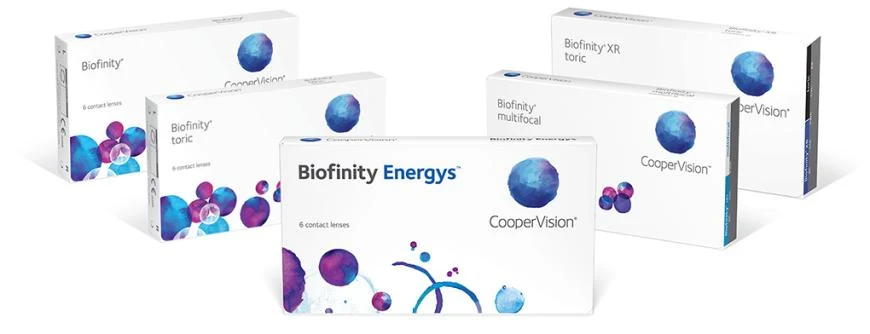
Biofinity Energys and Acuvue Oasys are part of larger product families. The Digital Zone Optics design in Biofinity Energys is only made as a spherical lens, so wearers with significant astigmatism or presbyopia use other lenses in the Biofinity family.
| Vision Need | Acuvue Oasys Family | Biofinity Family |
|---|---|---|
| Nearsightedness or farsightedness | Acuvue Oasys | Biofinity Energys or Biofinity |
| Astigmatism | Acuvue Oasys for Astigmatism | Biofinity Toric |
| Presbyopia | Acuvue Oasys Multifocal | Biofinity Multifocal |
| Astigmatism with presbyopia | Acuvue Oasys MAX 1-Day Multifocal for Astigmatism (daily disposable) | Biofinity Toric Multifocal (made to order) |
The technologies used in the toric and multifocal versions aren’t necessarily identical to those in the standard spherical lenses. Your prescription, eye measurements, vision needs, and contact lens fitting will determine which design is appropriate.
Biofinity Energys vs Acuvue Oasys Cost and Annual Lens Use
Comparing contact lens cost involves more than looking at the price of one box. Biofinity Energys and Acuvue Oasys follow different replacement schedules, which affects how many individual lenses you use over a year.
Several factors can affect the yearly cost.
- Biofinity Energys is replaced monthly, while Acuvue Oasys is replaced every two weeks. This means the number of individual lenses needed over a year will differ.
- Both lenses commonly come in 6-packs. A full year for both eyes is about 4 boxes of Biofinity Energys, compared with about 9 boxes of Acuvue Oasys.
- Retail prices, rebates, and promotions can change, so comparing the cost of a full-year supply gives you a more useful picture than looking at the price of one box alone.
- Reusable lenses also need contact lens solution all year, so factor that into the total.
A monthly replacement schedule uses fewer individual lenses during the year, but that doesn’t automatically make Biofinity Energys the less expensive choice. If you’re asking, “Are contact lenses expensive?” compare the cost of a full-year supply for your prescription rather than relying on the price of a single box.
You can browse Acuvue Oasys contact lenses or Biofinity Energys at VisionPros Canada to compare current prices.
Acuvue Oasys 1-Day for Astigmatism vs Dailies Total1 for Astigmatism Questions Answered
Is Biofinity Energys better than Acuvue Oasys for people who spend long hours on screens?
Neither lens is better for everyone. Biofinity Energys adds a small +0.30D centre boost designed to ease the focusing effort needed for screen distances, and it’s replaced monthly. Acuvue Oasys is replaced every two weeks and features HYDRACLEAR PLUS Technology and Class 1 UV blocking, but it has no near-focus boost. The better option depends on your prescription, how your eyes feel by the end of a screen-heavy day, lens fit, and wearing preferences.
Which lasts longer, Biofinity Energys or Acuvue Oasys?
Biofinity Energys has a longer replacement cycle because it is replaced monthly. Acuvue Oasys is replaced every two weeks, which means a fresh lens surface more often. If your lenses start to feel dry or tired late in a long workday, mention it to your eye care professional rather than stretching them past their replacement date. Always follow the replacement schedule they recommend.
Can you switch from Acuvue Oasys to Biofinity Energys?
Switching contact lens brands should involve an eye care professional. Biofinity Energys has a single 8.6 mm base curve, while Acuvue Oasys comes in 8.4 mm and 8.8 mm, so the same prescription power doesn’t necessarily mean the lenses will fit the same way. If screen time is the reason you’re thinking about switching, bring it up at your next visit so your eye care professional can check your fit and prescription first.
Are Biofinity Energys and Acuvue Oasys made from the same material?
No. Biofinity Energys is made from comfilcon A with Aquaform Technology, while Acuvue Oasys is made from senofilcon A with HYDRACLEAR PLUS Technology. Both are silicone hydrogel materials, but they differ in water content, oxygen transmissibility, and how they hold moisture, which can matter when you blink less during screen use.
Which is more breathable, Biofinity Energys or Acuvue Oasys?
Biofinity Energys has a published oxygen transmissibility of 171 Dk/t at -3.00D, while Acuvue Oasys is listed at 147 Dk/t at -3.00D. Oxygen transmissibility is only one factor in contact lens performance, so a higher value doesn’t automatically mean better comfort or fit, even over a long day at a screen.
This page is for informational purposes only. For medical advice or diagnosis, talk to an eye care professional.
References
CooperVision Canada. (n.d.). Biofinity Energys. https://coopervision.ca/practitioner/our-products/biofinity-family/biofinity-energys
CooperVision Canada. (2021). Product specifications, Canada. https://coopervision.ca/sites/coopervision.ca/files/coopervision-product-specifications-canada-en.pdf
CooperVision. (n.d.). Biofinity and Biofinity XR. https://coopervision.com/practitioner/our-products/biofinity-family/biofinity-biofinityxr
CooperVision. (n.d.). Biofinity toric multifocal. https://coopervision.com/practitioner/our-products/biofinity-family/biofinity-toric-multifocal
Johnson & Johnson Vision Care. (2025). ACUVUE technical specification guide. https://shop.acuvue.com/pub/media/ACUVUE-Technical-Specification-Guide-05-27-25.pdf
ACUVUE Canada. (n.d.). Patient instruction and product guides. https://www.acuvue.com/en-ca/patient-instruction-guides
ACUVUE. (n.d.). ACUVUE OASYS MULTIFOCAL with PUPIL OPTIMIZED DESIGN. https://www.acuvue.com/en-us/products/acuvue-oasys-multifocal/
Centers for Disease Control and Prevention. (2025). About contact lens types. https://www.cdc.gov/contact-lenses/about/about-contact-lens-types.html
Centers for Disease Control and Prevention. (2025). Preventing eye infections when wearing contacts. https://www.cdc.gov/contact-lenses/prevention