








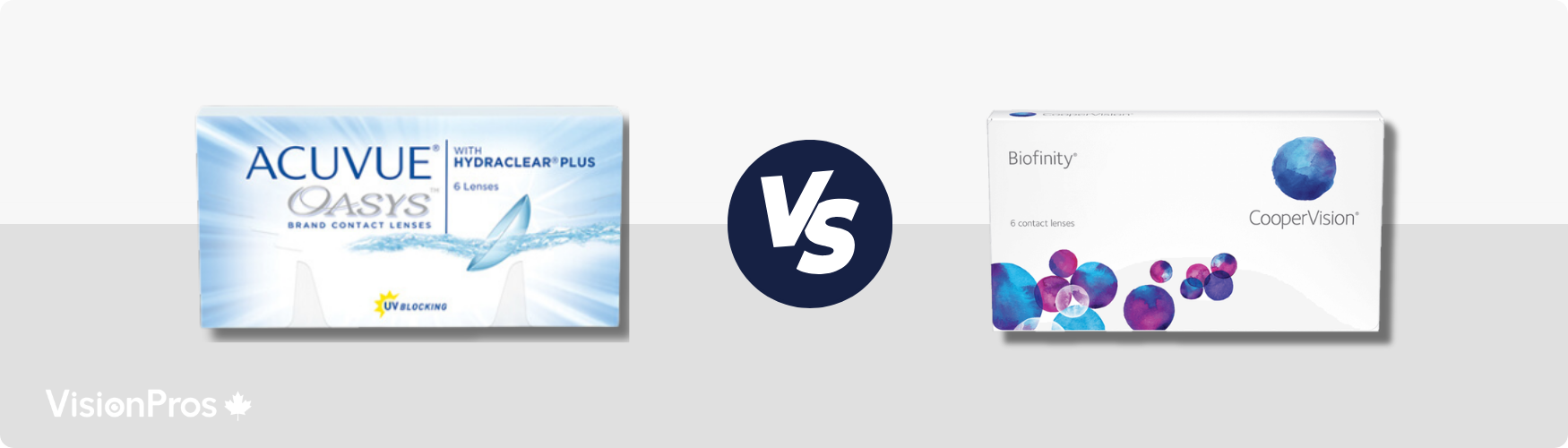
Acuvue Oasys and Biofinity are both popular contact lens options, but they take different approaches to comfort and wear. Both are reusable silicone hydrogel lenses that allow plenty of oxygen to reach the eyes, though they differ in material, moisture technology, replacement schedule, and other design features.
One of the biggest differences is how frequently you replace them. Acuvue Oasys is replaced every two weeks with daily wear, while Biofinity follows a monthly replacement schedule. Comparing these features can help you decide which lens best matches your prescription, wearing habits, and everyday routine.
Lens Features and Specifications Compared
Acuvue Oasys and Biofinity share some similarities, but their specifications show several differences in how they are designed and worn. Looking at their materials, water content, oxygen transmissibility, replacement schedules, moisture technologies, UV protection, and prescription options gives a clearer view of how the two lenses differ.
| Feature | Acuvue Oasys | Biofinity |
|---|---|---|
| Manufacturer | Johnson & Johnson Vision | CooperVision |
| Lens type | Silicone hydrogel | Silicone hydrogel |
| Material | Senofilcon A | Comfilcon A |
| Water content | 38% | 48% |
| Oxygen transmissibility | 147 Dk/t at -3.00D | 171 Dk/t at -3.00D |
| Replacement schedule | Every two weeks for daily wear | Monthly |
| Moisture technology | HYDRACLEAR PLUS Technology | Aquaform Technology |
| UV blocking | Class 1 UV blocking | No UV-blocking feature listed for standard Biofinity |
| Extended wear | Up to one week when prescribed for extended wear | Up to 29 nights and 30 days when prescribed |
| Astigmatism option | Yes | Yes |
| Multifocal option | Yes | Yes |
What Makes Acuvue Oasys and Biofinity Different?
Acuvue Oasys is a two-week reusable lens made from senofilcon A. HYDRACLEAR PLUS Technology incorporates a wetting agent into the lens material to help maintain moisture and support a stable tear film. The lens also includes Class 1 UV blocking.
Biofinity is a monthly reusable lens made from Comfilcon A and features Aquaform Technology. The material is designed to bind water within the lens while maintaining high oxygen transmissibility without relying on a surface coating. Its monthly replacement schedule also means each pair is worn longer before replacement compared with Acuvue Oasys.
Neither replacement schedule is automatically better. Some people prefer changing reusable contacts more frequently, while others find a monthly schedule easier to fit into their routine.
Materials, Water Content, and Breathability
Both lenses are made from silicone hydrogel, a material that allows more oxygen to reach the eyes than traditional hydrogel materials. Their specific materials, water content, and oxygen transmissibility differ.
Acuvue Oasys Material and Design
Acuvue Oasys uses senofilcon A with a water content of 38%. Its oxygen transmissibility is listed at 147 Dk/t for a -3.00D lens. HYDRACLEAR PLUS Technology helps maintain moisture within the lens and supports tear-film stability during wear.
Biofinity Material and Design
Biofinity is made from comfilcon A with a water content of 48% and an oxygen transmissibility of 171 Dk/t at -3.00D. Aquaform Technology binds water within the lens material, helping create natural wettability without surface coatings or treatments.
Biofinity has higher published water content and oxygen transmissibility than Acuvue Oasys, but these numbers don’t determine comfort on their own. Lens design, fit, tear-film characteristics, and wearing time can all influence how a contact lens feels on your eyes.
How Do Acuvue Oasys and Biofinity Compare for Wearing Comfort?
Wearing comfort depends on more than lens specifications alone. Acuvue Oasys and Biofinity use different moisture technologies and lens materials, which can affect how each lens feels throughout the day. Factors such as fit, tear-film quality, and wearing time can also influence your overall experience.
- Acuvue Oasys uses HYDRACLEAR PLUS Technology, which incorporates a wetting agent throughout the lens material. Biofinity uses Aquaform Technology, which attracts and binds water within the lens.
- Acuvue Oasys contains 38% water, while Biofinity contains 48%. A higher water content doesn’t automatically mean better comfort because lens material and tear-film interaction also play a part.
- Acuvue Oasys is replaced every two weeks with daily wear, while Biofinity follows a monthly replacement schedule. Some wearers may prefer changing reusable lenses more frequently, while others may find a monthly schedule more convenient.
- Comfort can also depend on how well a lens fits your eyes. Base curve, diameter, material, lens design, and other characteristics vary between brands, so switching lenses should be discussed with an eye care professional rather than relying on prescription power alone.
Two-Week vs Monthly Replacement Schedules
The replacement schedule can affect how you manage your lenses, how frequently you open a fresh pair, and how many lenses you use throughout the year. Whichever schedule you follow, proper cleaning, storage, and timely replacement are important for safe and comfortable wear.
| Lens | Replacement Schedule | Approximate Lenses Used Per Eye Each Year |
|---|---|---|
| Acuvue Oasys | Every two weeks | About 26 |
| Biofinity | Monthly | About 12 |
UV Protection
UV protection is one area where Acuvue Oasys and Biofinity differ. UV-blocking contact lenses can help reduce exposure to ultraviolet rays, but they don’t cover the entire eye or surrounding skin, so UV-protective sunglasses are still recommended.
UV Blocking With Acuvue Oasys
Acuvue Oasys includes Class 1 UV blocking. Manufacturer information lists the standard two-week lens as blocking more than 99.9% of UVB rays and approximately 96% of UVA rays.
UV Protection With Biofinity
Standard Biofinity isn’t listed as a UV-blocking contact lens in CooperVision’s current product specifications. Wearers who spend time outdoors should still use appropriate UV-protective eyewear.
Can You Sleep in Acuvue Oasys or Biofinity?
Both Acuvue Oasys and Biofinity have extended-wear indications, but overnight wear should only be considered when an eye care professional determines it is suitable for your eyes. Acuvue’s technical specifications list Acuvue Oasys for up to one week of extended wear, while CooperVision Canada lists Biofinity for daily wear or extended wear for up to 29 nights and 30 days.
Extended-wear approval doesn’t mean sleeping in contact lenses is risk-free. Sleeping in contacts is associated with a higher risk of contact lens-related eye infections, even when the lenses are approved for overnight wear.
If extended wear has been prescribed, keep these points in mind.
- Follow the wearing schedule given by your eye care professional.
- Don’t extend overnight wear beyond the prescribed period.
- Remove your lenses if you experience pain, unusual redness, blurred vision, excessive tearing, or other unexpected symptoms.
- Give your eyes the lens-free periods recommended by your eye care professional.
- Continue attending regular contact lens checkups.
Contact Lens Options for Different Vision Needs
Acuvue Oasys and Biofinity are product families rather than single lens designs. Both include options for common vision needs beyond standard nearsightedness and farsightedness.
| Vision Need | Acuvue Oasys Family | Biofinity Family |
|---|---|---|
| Nearsightedness or farsightedness | Acuvue Oasys | Biofinity |
| Astigmatism | Acuvue Oasys for Astigmatism | Biofinity Toric |
| Presbyopia | Acuvue Oasys Multifocal | Biofinity Multifocal |
| Astigmatism with presbyopia | Product availability varies | Biofinity Toric Multifocal |
The technologies used in the toric and multifocal versions aren’t necessarily identical to those in the standard spherical lenses. Your prescription, eye measurements, vision needs, and contact lens fitting will determine which design is appropriate.
Acuvue Oasys vs Biofinity Cost and Annual Lens Use
Comparing contact lens cost involves more than looking at the price of one box. Acuvue Oasys and Biofinity follow different replacement schedules, which affects how many individual lenses you use over a year.
Several factors can affect the yearly cost.
- Acuvue Oasys follows a two-week replacement schedule, while Biofinity is replaced monthly. This means the number of individual lenses needed over a year will differ.
- The number of lenses included in each box affects how many boxes you’ll need for a full-year supply.
- Toric, multifocal, extended-range, and other specialized prescriptions can be priced differently from standard spherical contacts.
- Retail prices, rebates, and promotions can change, so comparing the cost of a full-year supply gives you a more useful picture than looking at the price of one box alone.
A monthly replacement schedule uses fewer individual lenses during the year, but that doesn’t automatically make Biofinity the less expensive choice. If you’re asking, “Are contact lenses expensive?” compare the cost of a full-year supply for your prescription rather than relying on the price of a single box.
Which Contact Lens May Suit Your Routine?
Your wearing habits and preferences can help narrow down which lens may fit more naturally into your routine. Consider how frequently you want to replace your lenses, which features matter to you, and how each lens feels after a proper fitting.
| Acuvue Oasys May Suit You If | Biofinity May Suit You If |
|---|---|
| You prefer replacing reusable lenses every two weeks. | You prefer a monthly replacement schedule. |
| You want built-in UV blocking as part of your contact lens design. | You prefer replacing your reusable lenses less frequently. |
| You prefer the feel and performance of senofilcon A with HYDRACLEAR PLUS Technology. | You prefer the feel and performance of comfilcon A with Aquaform Technology. |
| You are already comfortable wearing lenses from the Acuvue Oasys family. | You are already comfortable wearing lenses from the Biofinity family. |
| Your eye care professional determines that Acuvue Oasys fits your eyes and prescription needs. | Your eye care professional determines that Biofinity fits your eyes and prescription needs. |
Acuvue Oasys vs Biofinity Questions Answered
Is Biofinity better than Acuvue Oasys?
Neither lens is better for everyone. Biofinity follows a monthly replacement schedule and uses Aquaform Technology, while Acuvue Oasys is replaced every two weeks with daily wear and features HYDRACLEAR PLUS Technology and Class 1 UV blocking. The better option depends on your prescription, lens fit, comfort, and wearing preferences.
Which lasts longer, Acuvue Oasys or Biofinity?
Biofinity has a longer replacement cycle because it is replaced monthly. Acuvue Oasys is replaced every two weeks when worn on a daily-wear schedule. Always follow the replacement schedule recommended by your eye care professional.
Can you switch from Acuvue Oasys to Biofinity?
Switching contact lens brands should involve an eye care professional. Acuvue Oasys and Biofinity differ in material, base curve, diameter, and lens design, so the same prescription power doesn’t necessarily mean the lenses will fit the same way.
Are Acuvue Oasys and Biofinity made from the same material?
No. Acuvue Oasys is made from senofilcon A, while Biofinity is made from comfilcon A. Both are silicone hydrogel materials, but they differ in water content, oxygen transmissibility, and other material properties.
Which is more breathable, Acuvue Oasys or Biofinity?
Biofinity has a published oxygen transmissibility of 171 Dk/t at -3.00D, while Acuvue Oasys is listed at 147 Dk/t at -3.00D. Oxygen transmissibility is only one factor in contact lens performance, so a higher value doesn’t automatically mean better comfort or fit.
References
Johnson & Johnson Vision Care. (2025). ACUVUE technical specifications.
https://shop.acuvue.com/pub/media/ACUVUE-Technical-Specification-Guide-05-27-25.pdf
ACUVUE. (n.d.). ACUVUE OASYS with HYDRACLEAR PLUS Technology.
https://www.acuvue.com/en-us/products/acuvue-oasys-2-week
ACUVUE Canada. (n.d.). Patient instruction and product guides.
https://www.acuvue.com/en-ca/patient-instruction-guides
CooperVision Canada. (n.d.). Biofinity.
https://coopervision.ca/practitioner/our-products/biofinity-family/biofinity
Centers for Disease Control and Prevention. (2025). About contact lens types.
https://www.cdc.gov/contact-lenses/about/about-contact-lens-types.html
Centers for Disease Control and Prevention. (2025). Preventing eye infections when wearing contacts.
https://www.cdc.gov/contact-lenses/prevention
U.S. Food and Drug Administration. (n.d.). Contact lens prescription.
https://www.fda.gov/medical-devices/contact-lenses/contact-lens-prescription
U.S. Food and Drug Administration. (n.d.). Buying contact lenses.
https://www.fda.gov/medical-devices/contact-lenses/buying-contact-lenses