








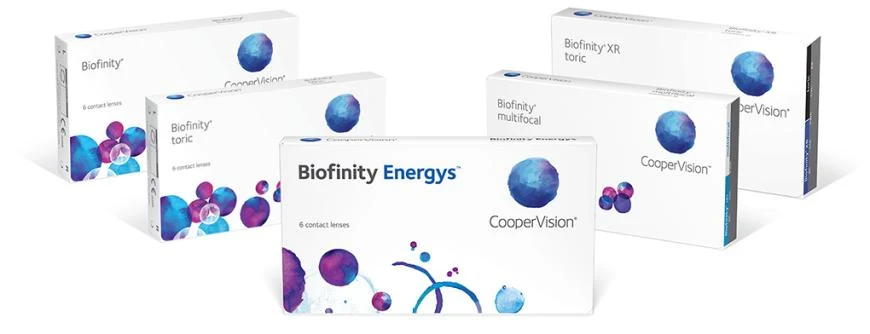
Both of these top-rated lenses are CooperVision monthly lenses made from comfilcon A silicone hydrogel, both hold 48% water, and both share an 8.6 mm base curve and a 14.0 mm diameter. What separates them is a front-surface optical design called Digital Zone Optics, which only Energys has, and a price gap of roughly $40 a box (varies).
So is a small change in optics, built for people who spend long hours looking at screens, worth paying more for? What follows is what CooperVision claims, what the published studies actually measured, and where the evidence can get thin.
The short version: Same material, same fit, same oxygen and moisture technology. Energys adds Digital Zone Optics to ease the focusing effort of screen work and costs roughly $40 more per box. The study measuring that effect was partly run by CooperVision, and a small outside study found a slight dip in sharpness with Energys. Neither lens blocks UV.
What’s the Difference Between Biofinity and Biofinity Energys?
Mostly one thing: the optics on the front surface of the lens. Here is how the two line up on CooperVision’s Canadian listings, with VisionPros list prices in the last row.
| Feature | Biofinity | Biofinity Energys |
|---|---|---|
| Manufacturer | CooperVision | CooperVision |
| Material | Comfilcon A (silicone hydrogel) | Comfilcon A (silicone hydrogel) |
| Water content | 48% | 48% |
| Oxygen transmissibility | 171 Dk/t at -3.00 D | 171 Dk/t at -3.00 D |
| Front-surface design | Aspheric | Aspheric with Digital Zone Optics |
| Base curve / diameter | 8.6 mm / 14.0 mm | 8.6 mm / 14.0 mm |
| Sphere power range | +8.00 D to -12.00 D | +8.00 D to -12.00 D |
| Replacement schedule | Monthly | Monthly |
| Wearing schedule (Canada) | Daily wear, or extended wear up to 29 nights/30 days | Daily wear, or extended wear up to 29 nights/30 days |
| UV blocking | No | No |
| Handling tint | Yes (light blue) | Yes (light blue) |
| Other versions | Toric, multifocal, toric multifocal, XR | Sphere only |
| List price (box of 6) | $53.95 | $93.95 |
Only three rows change: the front-surface design, the other versions you can choose from, and the price. Everything else, including the moisture technology that Energys is often credited for, is shared.
How Digital Zone Optics Works
Reading a screen keeps your eyes focused at one close distance for hours, and focusing is muscle work. Optometrists call it accommodation. You also blink less while you look: about 15 times a minute is normal, and staring at a screen can cut that to half or less, according to Aston University researchers. A 2018 review in BMJ Open Ophthalmology estimated that digital eye strain may affect 50% or more of computer users, and sorted the symptoms into two camps: focusing strain and dry eye.
Digital Zone Optics is aimed at the first camp. CooperVision describes it as multiple aspheric curves across the front surface that spread power so the centre of the lens simulates slightly more positive power. The idea is to cut the effort your eyes make when they swing from the screen to something across the room and back. The Spanish researchers who tested it compare the design to an aspheric multifocal, though it isn’t one: CooperVision says Energys “fits like a single-vision lens,” and it is made for ordinary nearsightedness and farsightedness, not for reading difficulty. CooperVision doesn’t publish how much extra plus power the design adds.
What the Research Shows
CooperVision’s headline number is that after one week, 8 in 10 digital device users said their eyes felt less tired in Energys. Read the footnote and that figure comes from people who already used screens at least four hours a day and reported eye fatigue weekly, and it is listed as “data on file,” meaning it hasn’t been published for outside scrutiny.
The one peer-reviewed paper that tests the design appeared in Contact Lens & Anterior Eye in 2020. The researchers measured accommodative micro-fluctuations, tiny rapid wobbles in focusing that increase when the focusing muscle is working hard, in 68 adapted lens wearers aged 25 to 35. Each person read on a phone held 25 cm away for 20 minutes, once in a standard Biofinity sphere and once in Energys, in randomized order. The change in micro-fluctuations was smaller with Energys (0.13 versus 2.25 in relative units, p = 0.017), which the authors read as less strain on the focusing muscle.
That’s a real signal, with limits worth knowing. It was a 20-minute lab task, not a month of workdays. It measured how the eye was focusing, not how people felt. And two of the three authors are affiliated with CooperVision.
Does Energys Cost You Some Sharpness?
Any lens that adds plus power to its centre invites the question, and a small study at Spain’s University of Valladolid put numbers on it. Fourteen young adults (average age 23) wore both lenses in random order, with neither they nor the examiner knowing which was which. With one eye covered, they read about 20/18 on average in Energys and about 20/15 in standard Biofinity, a gap of roughly four letters on an eye chart. With both eyes open the gap shrank to about half a line. Contrast sensitivity at one fine-detail setting was lower in Energys, and two higher-order aberrations were measurably higher, although the overall aberration total didn’t differ.
Keep it in proportion. Energys wearers still averaged better than 20/20, and the authors noted that people might not notice the difference. An earlier study from the same group found that wearers didn’t report more blur on a symptom scale. Against that, this was 14 people, all young, measured at a single visit about 15 minutes after the lenses went in, so it can’t say what a month feels like. The practical reading: most wearers probably won’t notice, but if you do detail work at distance or drive a lot at night, pay attention during a trial.
What Both Lenses Share
Energys marketing talks about dryness, but that comes from Aquaform Technology, and regular Biofinity has Aquaform too. It’s built into the material: CooperVision says the longer silicone chains attract and hold water, so less silicone is needed to reach high oxygen transmission. If your main complaint is dryness rather than tired focusing, Energys isn’t a moisture upgrade, and you’d be paying for the optics alone. Our guide to why contacts feel dry covers what actually helps.
Oxygen is the same for both, listed at 171 Dk/t at -3.00 D on CooperVision Canada’s pages. Both carry a light handling tint. Neither blocks UV, so sunglasses still earn their keep on bright days.
Can You Sleep in Biofinity or Biofinity Energys?
Both carry an extended-wear indication, which is unusual for a lens built around screen use, but the limit depends on where you read it. CooperVision Canada lists daily wear or extended wear up to 29 nights/30 days for both; CooperVision’s U.S. site says up to 6 nights/7 days. Follow the label in your box, and ask your optometrist whether overnight wear is appropriate for you at all. The CDC advises against sleeping in lenses unless your eye care provider has told you to. Being permitted to sleep in a lens isn’t the same as it being a good idea for your eyes.
Is Energys Worth the Extra Money?
At the time of writing, a box of six Biofinity lists at $53.95 at VisionPros and Energys at $93.95. A box covers six months for one eye, so both eyes for a year takes four boxes: about $216 for Biofinity and $376 for Energys, a difference of roughly $160 a year before any subscription savings.
Before spending it, try the free fixes first. The 2018 review lists correcting your prescription, managing dry eye and taking regular screen breaks among the main approaches. In a small trial of 29 symptomatic computer users, reminders to follow the 20-20-20 rule (every 20 minutes, look at something 20 feet away for 20 seconds) reduced eye strain and dry-eye symptoms while people used them, though the benefit faded within a week of stopping. Boring advice, but it’s free.
If you’ve done that, your eyes still feel heavy by mid-afternoon, and your job lives on a screen, a month in Energys is a sensible experiment, as long as you treat it like one. Ask your optometrist about trying a pair first, give it a fair run of a couple of weeks, and if you can’t tell the difference, keep the lower-priced lens.
Which One Fits Your Day?
Screens fill your workday and your eyes feel tired by the afternoon. Energys is the one worth trialling. It’s the only lens here designed for that complaint, even if the evidence is modest.
Your eyes feel fine and you care most about crisp distance vision, for driving, sport or detailed work. Standard Biofinity is a reasonable place to start, and it costs less.
Your lenses feel dry rather than tired. Neither one is a fix on its own, since the moisture technology is identical. Look at the habits and lens options in our guide to dry-feeling contacts, and talk to your optometrist about whether a different lens would suit you better.
When Neither One Fits
Energys comes in sphere only. If you have astigmatism, look at Biofinity Toric. If reading is the struggle, which often starts around 40, Biofinity Multifocal is built for it. If your prescription falls outside +8.00 D to -12.00 D, Biofinity XR stretches the range to +15.00 D and -20.00 D. And if you’re still deciding between monthly lenses and dailies, our guide to daily, bi-weekly or monthly lenses walks through the trade-offs.
Switching Between Them
Because the material, base curve and diameter match, the fit should feel very similar. The Valladolid team found no fit differences between the two. A contact lens prescription is written for a specific brand, though, so have your optometrist update it rather than swapping on your own. And if you’re curious how Energys compares with a lens that tackles screen comfort a different way, we’ve put it up against Bausch + Lomb ULTRA.
Ready to try one? Browse Biofinity and Biofinity Energys, or see every CooperVision monthly lens we carry at VisionPros Canada. Have your current prescription handy when you order.
This page is for informational purposes only. For medical advice or diagnosis, talk to an eye care professional.
References
CooperVision Canada. Biofinity® (practitioner product page). coopervision.ca. 2026.
CooperVision Canada. Biofinity® Energys™ (practitioner product page). coopervision.ca. 2026.
CooperVision Canada. Biofinity Energys® (patient product page). coopervision.ca. 2026.
CooperVision Canada. Product Specifications, Canada (PDF). coopervision.ca. 2023.
CooperVision UK. Digital Zone Optics™ Lens Design. coopervision.co.uk. 2026.
CooperVision. Biofinity® Contact Lenses (U.S. practitioner page). coopervision.com. 2026.
Kajita M, Muraoka T, Orsborn G. Changes in accommodative micro-fluctuations after wearing contact lenses of different optical designs. Cont Lens Anterior Eye. 2020;43(5):493-496.
Valencia Sandonís C, Arroyo del Arroyo C, López de la Rosa A, et al. Cambios en la calidad visual asociados al uso de las lentes de contacto Biofinity Energys. Cienc Tecnol Salud Vis Ocul. 2021;19(1):59-67.
Sheppard AL, Wolffsohn JS. Digital eye strain: prevalence, measurement and amelioration. BMJ Open Ophthalmol. 2018;3(1):e000146.
Talens-Estarelles C, Cerviño A, García-Lázaro S, et al. The effects of breaks on digital eye strain, dry eye and binocular vision: Testing the 20-20-20 rule. Cont Lens Anterior Eye. 2023;46(2):101744.
Optometry Today. Aston researchers confirm 20-20-20 guidance. aop.org.uk. 2022.
Centers for Disease Control and Prevention. Preventing Eye Infections When Wearing Contacts. cdc.gov. 2026.