



Updated October 28, 2026
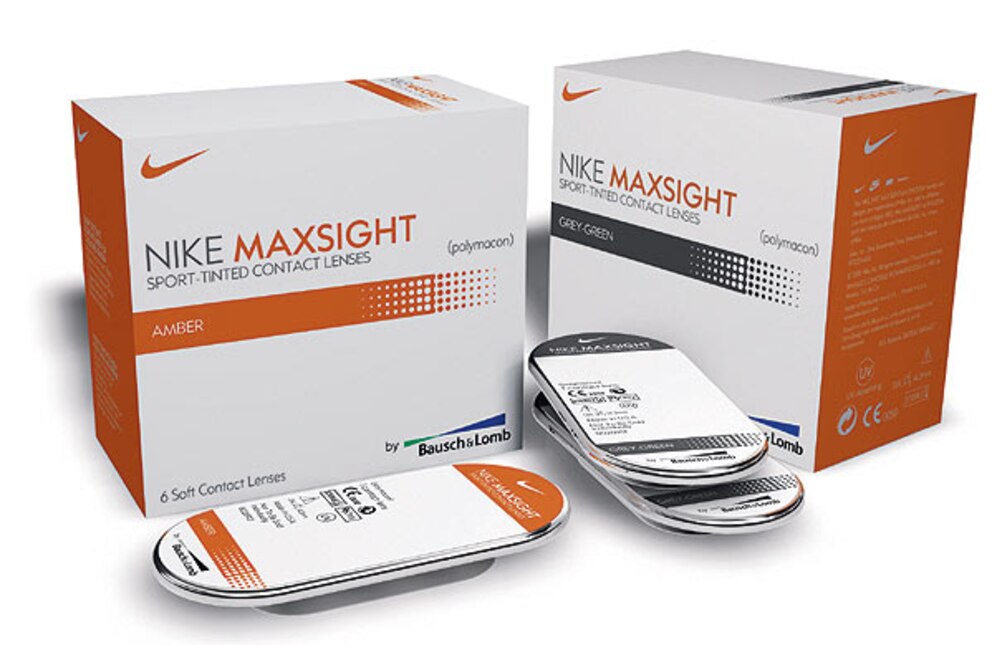
Nike MaxSight contact lenses were sport-tinted soft contacts developed by Nike and Bausch & Lomb to help athletes see more comfortably and distinguish objects in outdoor light. Introduced in 2005, they came in amber and grey-green versions, with prescription and non-corrective options. They have been discontinued for years and are no longer manufactured. [1, 3, 4]
We get the appeal, a contact lens that puts a sports tint directly on your eye. There are no sunglass frames to slip, and the tint moves with your gaze. It was an unusual product from a familiar brand, and people still want to know whether anything like it exists today.
What made Nike MaxSight different?
MaxSight combined a soft contact lens with a tint designed to change the light reaching the eye. Its purpose was to make certain outdoor visual tasks easier, such as picking out a moving ball against its background.
The lenses were made from polymacon, a hydrogel contact lens material. They could correct nearsightedness or farsightedness, but they were also offered in plano, or zero-power, versions for people who did not need vision correction. [2, 4]
They were reusable lenses, generally marketed for monthly replacement. Wearers had to remove, clean, disinfect and store them between uses. “Monthly” referred to the replacement schedule; it did not mean leaving the lenses in continuously for a month. [4, 6]
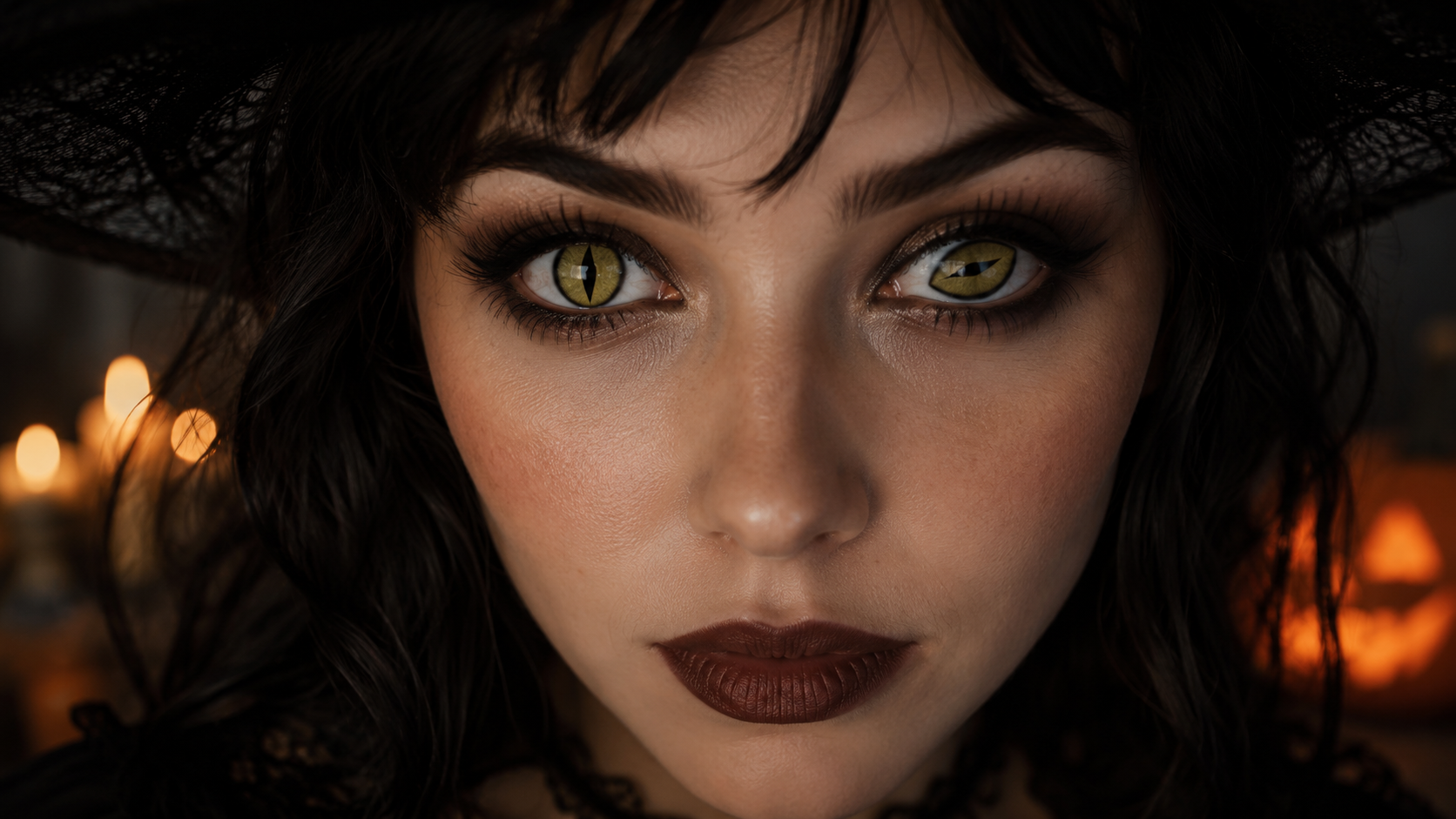
Another distinction matters if you are comparing them with coloured contacts. MaxSight’s tint extended across the area you looked through. A cosmetic colour and a performance tint serve different purposes. A lens that makes your eyes look a similar colour should not be assumed to produce MaxSight’s visual effect.
In a 2006 CNN interview, vision researcher Alan Reichow described MaxSight as a way to put a performance tint directly on the eye. He also made clear that it was developed for sport, rather than driving. [5]
Amber vs grey-green, what were the two tints for?
The two MaxSight colours were intended for different visual demands. Both were fixed tints, meaning they did not automatically darken and lighten as conditions changed.
| MaxSight tint | How it was positioned | Examples |
|---|---|---|
| Amber | Helping a moving object stand out against its background | Baseball, tennis, soccer and other ball sports |
| Grey-green | Managing bright outdoor light and helping distinguish contours | Golf, running and cycling |
Those were the intended uses, rather than a guarantee that every athlete would prefer the recommended colour. [11, 12]
The lenses also reduced the amount of visible light entering the eye. In a published MaxSight study, the amber lens transmitted about 50% of visible light, while the grey-green lens transmitted about 36%. Those percentages describe visible-light transmission, not UV protection. [7]
This helps explain the “sunglasses for your eyes” description you may have seen. It is a useful shorthand for the tint, but contact lenses do not provide the same coverage as sunglasses.
The history of Nike MaxSight
The idea grew out of sports-vision research associated with Pacific University and work with Paragon Vision Sciences. According to ALTIUS’s history of the project, earlier SportSight lenses attracted Nike’s attention and eventually became MaxSight through a partnership with Bausch & Lomb. [4]
The commercial launch was in 2005. The U.S. Food and Drug Administration records a clearance decision on April 26, 2005, and Bausch & Lomb’s annual report confirms that it introduced the lenses in the United States and Europe that year. [1, 3]
MaxSight received attention well beyond optometry. TIME included the lenses in its Best Inventions coverage in November 2005. The magazine reported that golfer Michelle Wie wore them during her professional debut. [6]
Baltimore Orioles second baseman Brian Roberts was another visible wearer. In CNN’s 2006 report, he described the lenses as reducing glare and helping him see the ball more comfortably. That was a player’s experience, rather than proof that the lenses would improve everyone’s results. [5]
The original product had a short commercial life. By the late 2000s, it had been discontinued.
Did Nike MaxSight contact lenses actually work?
There was research behind the concept, although its findings were more specific than some of the claims repeated online.
A 2009 study involving 33 participants found advantages over clear comparison lenses in several bright-sunlight vision tests, including contrast discrimination and visual recovery. Participants also preferred the tinted lenses in the tested conditions. Nike provided participant compensation, Bausch & Lomb supplied lenses, and two authors disclosed consulting work for Nike. [7]
A separate 2011 study involving 17 participants found better low-contrast visual acuity with amber MaxSight lenses than with clear lenses in bright outdoor conditions. Adding eye-black grease to the MaxSight lenses did not produce a further improvement. [8]
The results were not uniformly positive across every optical measure. A 2008 study of 13 participants found increased retinal straylight with the grey-green lenses compared with the clear comparison lens. The authors did not expect the changes to cause clinically significant differences in daylight visual function. [9]
These small studies support a narrower conclusion: MaxSight could help with some visual tasks under particular lighting conditions. They do not establish that wearing the lenses would improve a batting average, lower a golf score or make someone a better athlete. A vision-test result and a competitive result measure different things.
Why were Nike MaxSight contact lenses discontinued?
There’s no single documented explanation in public accounts. ALTIUS, whose team includes people involved in developing the original concept, dates MaxSight’s withdrawal to 2008. In an interview published by ABB Optical Group, ALTIUS founder Alan Reichow said Nike chose to stop after problems involving a lens-care solution associated with the product. That is an account from someone connected to the project, rather than a contemporaneous Nike discontinuation announcement. [10, 11]
A separate 2014 retrospective by optometrists Patrick Caroline and Mark André put the withdrawal in 2007 and suggested several contributing factors, including fitting limitations, the conspicuous appearance of the tint, marketing and the absence of a daily disposable version. Those were the authors’ assessments, not an official explanation from Nike. [12]
The FDA documented a 2006 recall of Bausch & Lomb’s ReNu with MoistureLoc solution following reports of Fusarium infections. That recall record identifies the solution; it does not establish a MaxSight lens defect or, by itself, explain Nike’s business decision. [13] Claims that MaxSight disappeared because it was banned for being “too effective” go beyond what these records establish.
Why do people still search for Nike MaxSight?
Part of the attraction is the product itself. Nike is a familiar name in sports equipment, but contact lenses are a less familiar part of its history. The combination of an unexpected product, distinctive tinted eyes and professional-athlete associations gives people plenty to be curious about.
There is also a practical question behind the nostalgia. Someone who dislikes wearing sunglasses during a game may still want the same basic thing MaxSight promised: a way to manage bright light without a frame on their face.
Online discussions show both kinds of interest. A Reddit thread asks directly for alternatives to Nike’s discontinued tinted contacts. In another discussion, a user says a video of the old Nike lenses prompted a search for something similar for hiking and beach days. These are individual examples, but they show how old products can keep finding new audiences. [14, 15]
Old retail pages add to the confusion. Some still appear with shopping-style titles, historical product information or “while supplies last” wording even though the product is marked unavailable. Landing on one can leave a reader wondering whether another seller still has it. [16] These are plausible reasons for the continued interest. They do not tell us what proportion of searches comes from former wearers, social media viewers, collectors or people looking for a current sports lens.
Can you still buy Nike MaxSight contact lenses?
Nike MaxSight is no longer a current, manufactured contact lens. An old product listing is not evidence of fresh stock, and a photograph of an unopened box does not establish that its contents are suitable to wear.
If you encounter original MaxSight lenses through a resale listing or a collector, treat them as memorabilia. Do not put expired lenses in your eyes. Health Canada’s labelling guidance explains that a device’s expiry date is based on the period during which it is demonstrated to meet its specifications. A sealed package does not make that date irrelevant. [26] Anyone looking for the visual effect should ask about current options instead of trying to track down wearable stock of the original product.
The alternatives to Nike MaxSight
The comparison depends on what attracted you to MaxSight: the sports tint, freedom from sunglass frames, vision correction or simply the way the lenses looked.
ALTIUS performance-tinted contact lenses
ALTIUS is the clearest modern counterpart to discuss with an eye care professional. The company traces its development to the original MaxSight project and offers amber and grey-green performance tints. Its lenses are single-use, rather than the reusable monthly format associated with MaxSight. [4, 17]
The manufacturer’s current information lists plano lenses and spherical minus powers from −0.50 to −6.00 dioptres. That range will not cover every prescription. [17]
For Canadian readers, availability needs checking. ALTIUS has a U.S. provider pathway, but a U.S. product page does not establish that a lens is licensed, distributed or available for fitting in Canada. Ask your Canadian eye care professional to confirm those details before treating it as an option you can order.
Specialty tinted lenses such as Orion BioSport
Orion Vision Group also lists a BioSport Tint range, with colours including amber, grey-green, green and yellow. This is another specialty product to ask about if a performance tint is your main interest. [18]
Canadian availability, the exact lens design, prescription options and care schedule should be confirmed by the professional fitting it. The presence of a colour in a catalogue does not establish that it will reproduce MaxSight’s filtering characteristics or suit your eyes.
Daily disposable contacts with suitable sports eyewear
If your main goal is clear vision during sport, a current contact lens prescription combined with appropriate sunglasses or protective sports eyewear is a practical route to discuss.
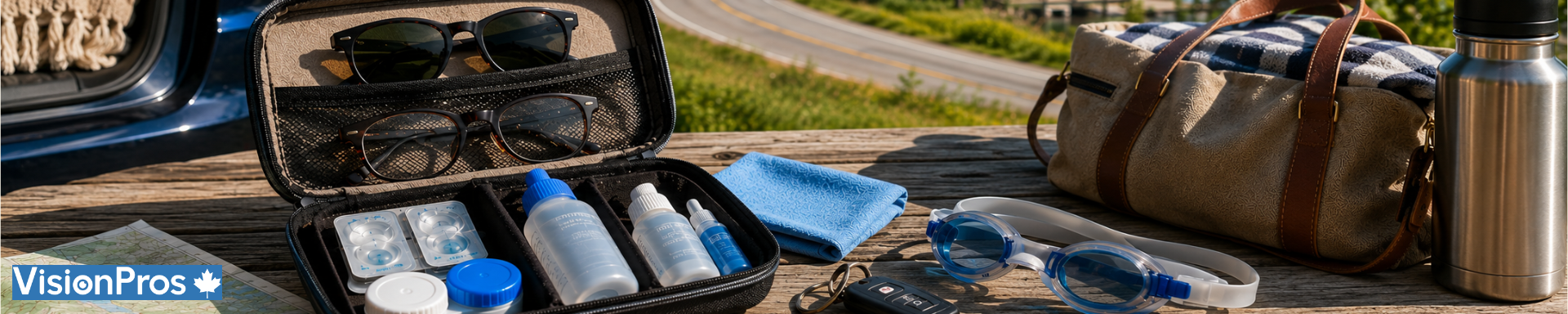
Examples of daily disposable lenses listed by VisionPros include ACUVUE OASYS 1-Day with HydraLuxe and MyDay daily disposable. Both have UV-blocking features, according to their Canadian manufacturers. Neither provides MaxSight’s amber or grey-green sports tint. [20, 21]
A fresh pair also removes the cleaning and storage steps associated with reusable lenses. Your eye care professional should choose the lens for your prescription, fit and comfort, including any need for astigmatism correction.
UV-blocking contacts still leave parts of the eye and surrounding skin uncovered. Health Canada advises that they do not provide full coverage, so sunglasses remain relevant outdoors. Contacts also provide no protection from a ball, stick or impact. [23, 24]
Prescription sports sunglasses or goggles
If you do not want contact lenses, prescription sports eyewear may address the underlying need. It can combine vision correction with a tint selected for your activity and lighting.
The frame and lens requirements depend on the sport. The Canadian Association of Optometrists recommends discussing appropriate protective eyewear with an optometrist. Everyday sunglasses should not automatically be treated as impact protection for activities such as hockey, squash or basketball. [24, 25]
What about ACUVUE OASYS with Transitions?
You may still see this lens recommended in older MaxSight alternative guides. ACUVUE OASYS with Transitions has also been discontinued, as confirmed by ACUVUE’s Canadian website. It’s not a current replacement to seek out. [19]
ACUVUE OASYS MAX 1-Day is a different product. It includes a blue-violet light filter, but it’s not a photochromic lens or a like-for-like substitute for MaxSight’s sports tints. Similar light-filtering language should not be taken to mean identical performance. [22]
Finding an option that fits your sport
Bring the reason you wanted MaxSight to your next eye appointment. Explain the sport you play, when glare bothers you, whether sunglasses interfere with your equipment and whether you need prescription correction.
If the tint itself is the priority, ask whether a current specialty lens is available and suitable. If the priority is comfortable vision during activity, an accurately fitted contact lens and the right eyewear may solve the problem.
Once your prescription is confirmed, you can explore contact lenses at VisionPros. Nike MaxSight may be part of sports-equipment history, but the need that made it interesting is still familiar: seeing comfortably when you are outside and moving.
References
- U.S. Food and Drug Administration. MaxSight (polymacon) Sport-Tinted Contact Lens, 510(k) K050157. Decision: April 26, 2005.
- U.S. Food and Drug Administration / Bausch & Lomb. K050157 summary of safety and effectiveness and indications for use. 2005.
- Bausch & Lomb. Annual report, Form 10-K: fiscal 2005 product introduction. SEC filing, 2007.
- ALTIUS / Performance Vision Technologies. The History of ALTIUS and MaxSight. June 12, 2023.
- CNN. CNN Saturday transcript: Alan Reichow and Brian Roberts on MaxSight. May 6, 2006.
- TIME. Best Inventions 2005: Game Point. November 13, 2005.
- Erickson GB and colleagues. Visual Performance with Sport-Tinted Contact Lenses in Natural Sunlight. Optometry and Vision Science, 2009;86:509–516. DOI: 10.1097/OPX.0b013e31819f9aa2.
- Horn FC and colleagues. Comparison of Low-Contrast Visual Acuity Between Eye Black and Maxsight Tinted Contact Lenses. Eye & Contact Lens, 2011;37:147–152. DOI: 10.1097/ICL.0b013e31820c6e09.
- Cerviño A and colleagues. Effect of Sport-Tinted Contact Lenses for Contrast Enhancement on Retinal Straylight Measurements. Ophthalmic and Physiological Optics, 2008;28:151–156. DOI: 10.1111/j.1475-1313.2008.00541.x.
- ALTIUS / Performance Vision Technologies. ALTIUS Stands Up to Critics. February 20, 2026.
- ABB Optical Group. Product Feature: Five Quick Questions with Dr. Alan Reichow, CEO of Altius. Accessed October 28, 2026.
- Caroline PJ and André MP. Contact Lens Case Reports: Tinted Lenses for Athletes. Contact Lens Spectrum, December 1, 2014.
- U.S. Food and Drug Administration. Class 1 Device Recall: ReNu with MoistureLoc, recall Z-1201-06. Firm initiated April 13, 2006; posted August 31, 2006.
- Reddit, r/Nike. Alternative to Nike Max Sight tinted contacts?. 2023 discussion.
- Reddit, r/contacts. UV Blocking Lenses?. 2026 discussion.
- Contacts America. Nike Maxsight: discontinued product listing. Accessed October 28, 2026.
- ALTIUS / Performance Vision Technologies. Frequently Asked Questions. Accessed October 28, 2026.
- Orion Vision Group. BioSport Tint product range. Accessed October 28, 2026.
- ACUVUE Canada / Johnson & Johnson. Discontinued ACUVUE products. Accessed October 28, 2026.
- ACUVUE Canada / Johnson & Johnson. ACUVUE OASYS 1-Day with HydraLuxe Technology. Canadian product information.
- CooperVision Canada. MyDay daily disposable. Canadian product information.
- ACUVUE Canada / Johnson & Johnson. ACUVUE OASYS MAX 1-Day. Canadian product information.
- Health Canada. Sunglasses. Accessed October 28, 2026.
- Health Canada. Contact Lenses. Accessed October 28, 2026.
- Canadian Association of Optometrists. Sports and Protective Eyewear. Updated January 14, 2025.
- Health Canada. Guidance for the Labelling of Medical Devices: soft and decorative contact lenses. Revised April 10, 2015.