







Blurry vision is one of the most common reasons Canadians book an eye exam, but knowing whether you are nearsighted or farsighted before you walk in can help you have a more informed conversation with your optometrist. Both conditions are refractive errors, meaning the eye does not focus light the way it should. They affect your vision in opposite ways and are corrected differently, whether you wear glasses, contact lenses, or both.
What Is Nearsightedness?
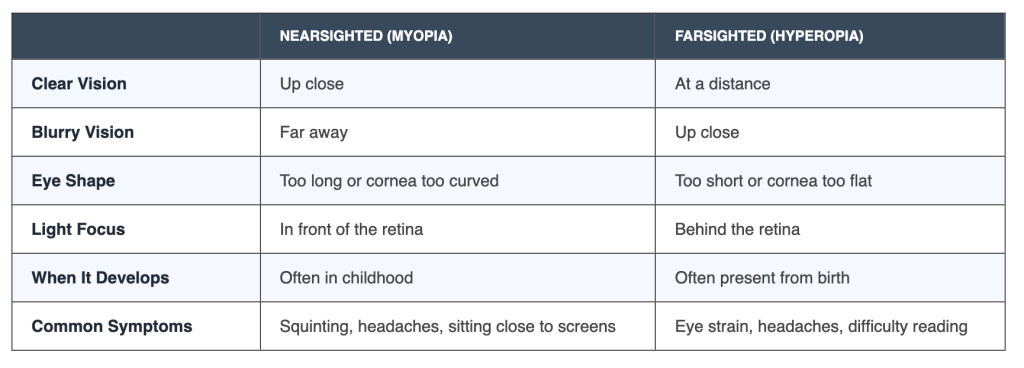
Nearsightedness, or myopia, means you can see things up close clearly but struggle to see objects at a distance. Reading and close-up work feel fine, but driving, watching a game, or reading a whiteboard can be a challenge.
Myopia occurs when light entering the eye focuses in front of the retina rather than directly on it. This happens because the eyeball is longer than average or the cornea curves too steeply. Myopia rates in Canada have been rising, particularly among school-aged children and young adults. It typically develops during childhood and can worsen through the teenage years as the eye grows.
Spending time outdoors has been shown to slow the progression of myopia in children. Research published in Ophthalmology found that outdoor time plays a protective role, likely due to exposure to natural light and changes in how the eye focuses at longer distances.
What Is Farsightedness?
Farsightedness, or hyperopia, means distant objects are usually clear but close-up tasks cause strain, blurring, and headaches. Reading, using a phone, and working on a screen all become tiring when hyperopia goes uncorrected.
With hyperopia, light focuses behind the retina instead of directly on it. The eyeball is shorter than average or the cornea is too flat to refract light correctly. Hyperopia is usually present from birth and tends to run in families. Young eyes can compensate for mild farsightedness on their own, but this ability decreases with age. Many adults notice symptoms for the first time in their 30s or 40s even if the condition has been present since childhood.
Nearsighted vs. Farsighted at a Glance
How Do You Know Which One You Have?
Notice where your vision is clearest. If distant objects are blurry but you have no trouble reading or using your phone, myopia is likely. If you can spot a street sign from a distance but your eyes strain when reading or doing close-up work, hyperopia is the more probable cause.
Children rarely realise their vision has changed. Signs to watch for include squinting, sitting too close to screens, frequent eye rubbing, and complaints of headaches after schoolwork. The Canadian Association of Optometrists recommends eye exams for children starting at six months, again at age two to three, and annually from school age onward.
How Glasses Correct Nearsightedness and Farsightedness
Glasses place a corrective lens in front of the eye to redirect light before it enters. For myopia, glasses use concave lenses that spread light slightly outward, shifting the focal point back onto the retina. For hyperopia, convex lenses bend light inward so it reaches the retina rather than overshooting it.
The prescription number tells you the strength of correction needed. A minus sign indicates myopia. A plus sign indicates hyperopia. The further the number from zero, the stronger the lens required.
How Contact Lenses Correct Nearsightedness and Farsightedness
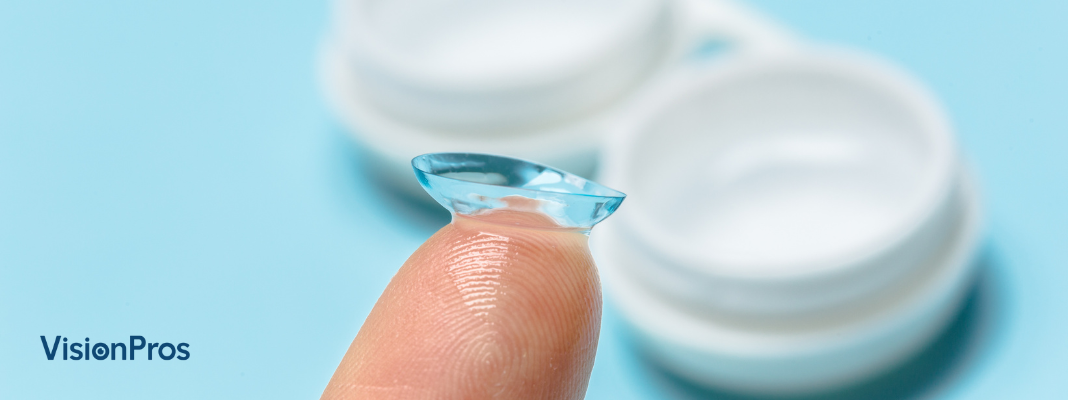
Contact lenses work the same way as glasses but sit directly on the cornea. This gives them a wider field of corrected vision since the lens moves with your eye rather than staying fixed in a frame.
Contacts for myopia shift the focal point backward onto the retina. Contacts for hyperopia move the focal point forward. Both conditions are correctable with single-vision lenses. Daily disposables are a convenient option since each day starts with a fresh lens. Silicone hydrogel lenses allow more oxygen to reach the cornea, a reliable choice for extended daily wear.
Can You Be Both Nearsighted and Farsighted?
Yes, though it is uncommon. In rare cases, one eye is nearsighted and the other is farsighted, a condition called antimetropia. Astigmatism can also occur alongside either condition, causing blur at multiple distances due to an irregular cornea shape. Toric contact lenses and glasses with a cylindrical correction address this.
Presbyopia is worth mentioning as well. It is an age-related condition that affects the eye’s ability to focus on close objects and is separate from myopia or hyperopia. People in their 40s and beyond can develop presbyopia on top of an existing refractive error. Bifocal or progressive glasses and multifocal contact lenses correct for both near and distance vision in a single lens.
If your optometrist has given you a prescription for myopia or hyperopia, Vision Pros carries a wide selection of contact lenses for both conditions. Your prescription works for glasses too, so you can switch between both as needed.
References
American Optometric Association. Myopia. AOA.org. 2023.
Canadian Association of Optometrists. Children’s Vision. CAO.ca. 2023.
Holden BA, et al. Global Prevalence of Myopia and High Myopia. Ophthalmology. 2016.
American Academy of Ophthalmology. Farsightedness Hyperopia. AAO.org. 2023.